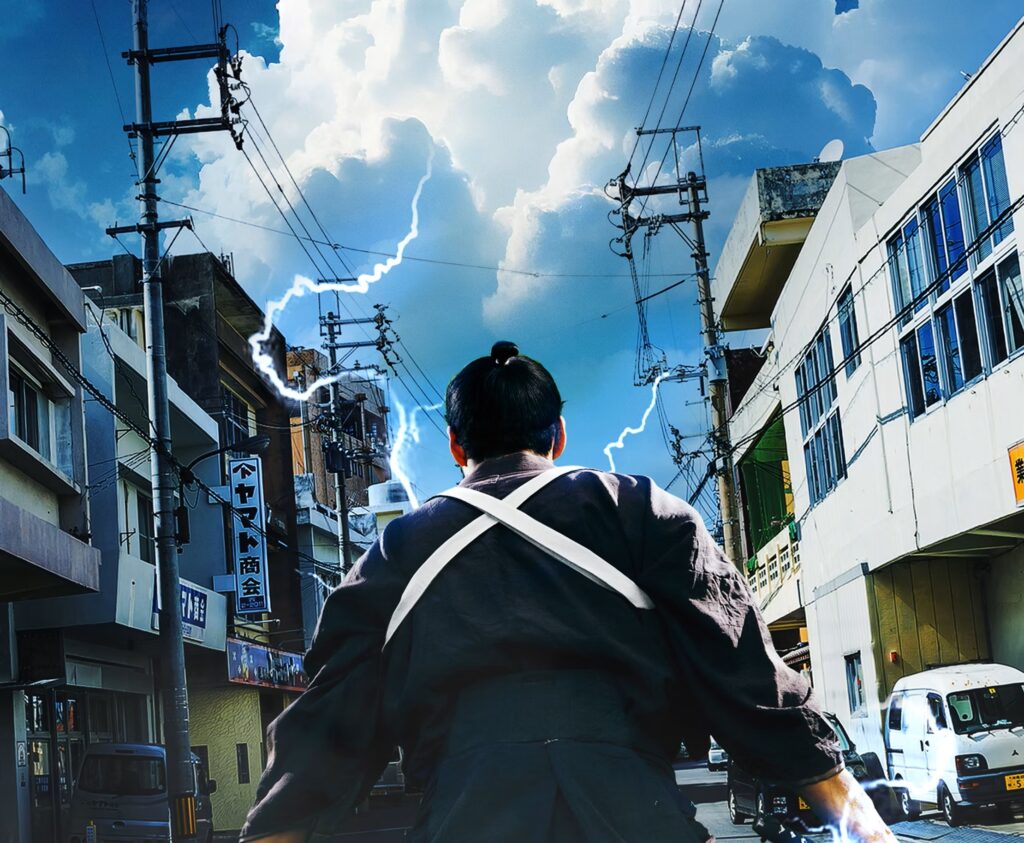
A Samurai in Time begins in Kyoto, Japan, during the Bakumatsu period of the mid-19th century, which marked the end of the Edo period. Supporters of the Tokugawa shogunate clash with forces loyal to the Empire. During a duel, Kosaka Shinzaemon, a pro-shogun Aizu samurai from Kyoto, is struck by lightning. He is transported through time and ends up in modern-day Kyoto on the set of a historical drama series recreating the Edo period. After a series of misunderstandings, he is hired as a kirareyaku (“actor who gets cut down”) because he embodies this bygone era perfectly and knows how to wield a sword.
The comedy A Samurai in Time (Samurai Taimu Surippā), written, directed, and produced by Jun’ichi Yasuda, could easily be called A Samurai on Time. A samurai arrives in the middle of filming a series recreating his era. Disoriented and confused by the time shift, the warrior arrives just in time to rescue a genre in decline. He starts out as an extra, passionately works his way up the ranks, and becomes a source of inspiration for the entire studio.
The romantic idyll between Kosaka Shinzaemon and Yuko Yamamoto, the director’s assistant, softens the violence of the time slip. Despite coming from different eras, the two characters’ shared passion for jidaigeki creates a semblance of unity. Kosaka’s physical and sartorial evolution facilitates his adaptation, without abolishing his samurai spirit.
The Japanese title of the film, Samurai Taimu Surippā, refers not only to a shift in time but also to the “splendor” of the samurai in an Americanized Japanese society where Edo traditions have largely disappeared. Thus, A Samurai in Time puts the temporal paradox into perspective: Is the loss of values not at least as absurd as this journey through time?
Jun’ichi Yasuda’s final film pays tribute to the heroes of jidaigeki. Situational comedy, the bizarre looks and postures of the extras, and mocking sound effects exist alongside the warrior’s code of honor and his hatred of the Japanese imperial forces.
Released on August 17, 2024 (Japan)
Running time : 131 minutes
Photo credits © Mirai Eiga-sha https://www.samutai.net